

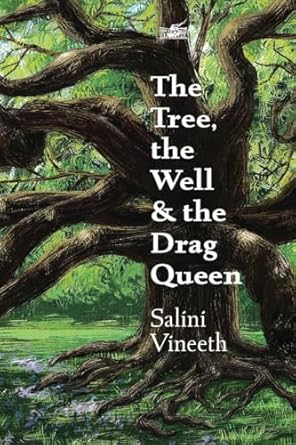
Delving into Salini Vineeth’s The Three, the Well and the Drag Queen was like falling headlong into a veritable Carrolesque rabbit hole, one from which I didn’t want to return, even when I knew the story was over and I had to come back to boring reality.
I lay amidst the delectable remnants of the finished tale, savouring the emotions and images it evoked, rethinking about the small, lovable boy, his grandmother, his mother, and his father, unwittingly trapped in the world created by someone before them, and wondering how this tale was restricted to just a novella instead of a full-fledged novel, maybe even a trilogy, the trend of the times! My grievance comes a little later.
Salini creates a fabulous fantasy world triggered by a vulnerability that evil finds easiest to prey upon, greed. As the scenes shift and meander through this fantastical world, from the original greedy couple who sell their souls for prosperity and domain control to the later ones inextricably trapped in this world, the unseen-but-unmistakably-felt-in-every-page-of-the-book Evil (beautifully allegorized as suppressed anger), I fell deeper and deeper in love with Salini’s highly evocative writing.
My heart went out to every generation of the cursed family, but most of all to the drag queen who transforms, most agonisingly yet beautifully and sensitively, from a vulnerable little one yearning for love to an intrepid saviour. I loved and savoured this journey of the drag queen.
The biggest problem with the book was that it was meant to be more, much more than a novella. I was disappointed with not having enough details of the multiple generations between the first ones who hit at the root of Evil to release it into the world and the final one that put it back in its place, how the family evolved from finding prosperity suddenly to what had become of it now. That part should have been given more words to be fleshed out well. That absent part left me wanting.
And the Kerala-ness of the story, replete with chathans, temple and village guardians, quintals of overly ripe, squishy, mushy, flabby jackfruit (with the power to bury their victims alive), added to the alluring authenticity of the tale.
By the way, I’ve never been a fan of jackfruit (the smelly fruit, not the raw one), ever. After reading Salini’s book, I reiterate my disdain for it. But rest assured, the poor jackfruit is not the villain, only a tool. Read the book if you want to know the real villain.
If you liked this review, you might like my review of Circe by Madeline Miller
This post is part of the Bookish League blog hop hosted by Bohemian Bibliophile.




What a lyrical review of what seems like a wonderful novella. You left me wanting to know more about the narrative.
I like jackfruit. 😛 But I would still read the book because I like the other world books too. Going by your review, it’s a short one, so easy peasy.
Very short, breezy and still runs deep in some parts. I hope you like it too
Salini has come a long way as a writer, and this book is proof of that. I am yet to read this one, but it is on my TBR, since I have heard such good things about it.
P.s. Not a fan of ripe jackfruit too, though I love the raw jackfruit subji
Yes, she has. This book shows her evolution. I loved it.
Chathans and a whole of spirits roam the landscapes of Kerala in the dark hours. I live in Kerala too. I’m yet to encounter any of those spirits though they abound in the state’s literature. Glad to come across another book on them.
I’m glad you and I don’t encounter these things in real life. But they do make fascinating characters for some great stories.