

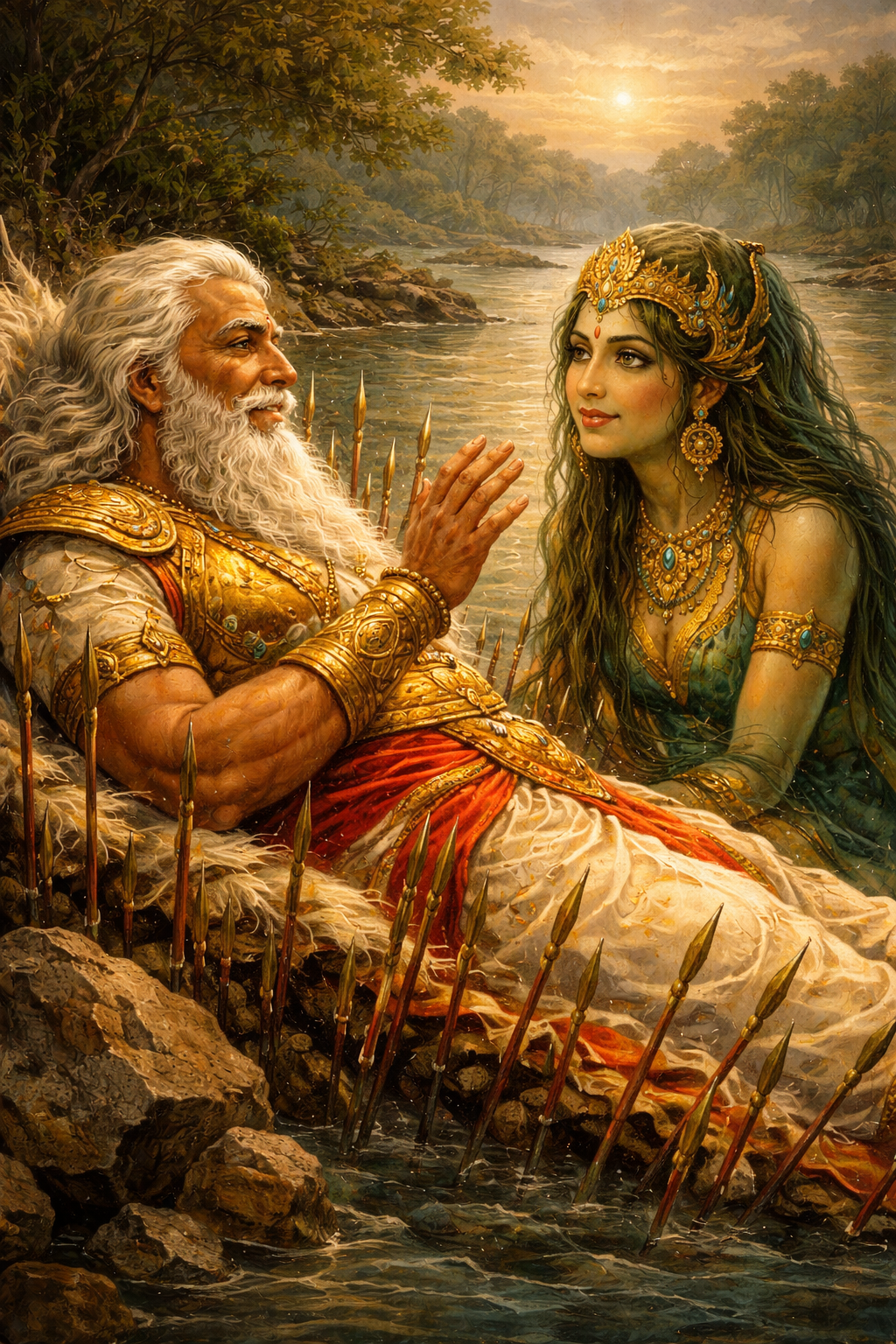
The Goddess of the River Oghavati felt both honoured and sad. Bhishma Pitamah had chosen her banks as the place to lie on the bed of arrows until he chose to die. Arjuna, with his deft, accurate archery skills, built a strong bed of arrows. The Kauravas and Pandavas, for once united, carried the fallen man, nay, the power that held the Kuru clan for three generations, to the bed and placed him gently on it.
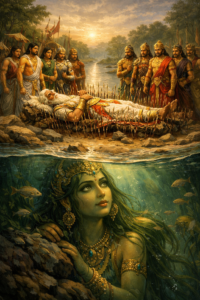
The arrow points that dug into Bhishma’s skin felt like homecoming to the man. He smiled in satisfaction and thanked his grand-nephews. There was not a single pair of dry eyes in the group that stood around him, deferentially.
I wish they showed this sense of unity and oneness all the time. But I know this is a temporary reprieve, until tomorrow morning when the battle call is given again.
Goddess of River Oghavati and Bhishma
He sent everyone away. “Go back to your tents. Suyodhana, I understand you need to appoint your new Commander-in-Chief, now that I am gone. And Yudhisthira, I know you have to strategise and plan for tomorrow. May Dharma win.”
When everyone had left, when Bhisma was alone, the Goddess of the River Oghavati appeared before him and bowed in reverence. “Sire, I am honoured that you chose to lie on the banks of my river.”
Bhishma opened his eyes and, finding the Goddess standing in front of him, replied, “That was an easy choice, Goddess Oghavati. The land of Kurukshetra was even more purified than before when Sage Vasishtha summoned you to flow through it during King Kuru’s yagna. The entire Kuru kingdom is honoured to have you and your divine presence.”
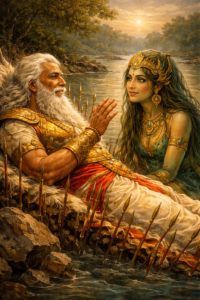
The Goddess smiled in gratitude. Then, hesitatingly, she asked, “Lord Bhishma, can I ask you a personal question?”
“At this stage in my life, I have no ‘personal’ left in me. My life is an open book. Go ahead and ask me. I’ll try and answer.”
“Do you ever regret taking the oath of celibacy?”
He looked at the Goddess, and the first response was laughter. She was abashed. “I’m sorry. That was very personal. I’m just curious. In fact, I believe that if you hadn’t taken that oath of celibacy, this war itself might not have taken place, considering it would’ve been your sons who would’ve got the mantle of the kingdom. The cousins fighting for the throne now wouldn’t have been in the fray at all.”
Bhishma laughed even harder. He winced when an arrowhead dug into his skin deeper than normal because he was shaking hard with laughter. He started coughing too. The Goddess brought him some water to drink, even as she apologised profusely for causing him pain. “I’m so sorry, Sire. It is not in my place. It was merely curiosity to know more about the human mind. Why do people do what they do?”
“No, no. Don’t apologise, my dear Goddess,” Bhishma replied, his throat soothed with the cool waters of River Oghavati. “I wish I knew what my life would have been if I hadn’t chosen to take the oath of celibacy. And yes, I have thought about that option many times. I didn’t take the oath for any other purpose than wanting my father to be happy so he could rule well without distractions. And having children to become heirs could be done by anyone, right? Is there any certainty that my children wouldn’t have fought among themselves for the throne?”
“Indeed, you are right. There is no certainty of outcome. Just actions and choices based on one’s own judgment.”
“And the karmic consequences that follow, both easy and difficult to deal with, confusing and clear, seemingly moral and immoral, and all in between,” finished Bhishma.
The two of them sighed as the truth of human life hit them, though not for the first time. “That’s why the best way to live is to give your best in any given situation and surrender the results to Him. Your karma will find a way to you, sooner or later.”
After a long conversation, Bhishma drifted off to sleep, and the Goddess of the River Oghavati stood, staring at the powerful warrior, his colossus not restricted merely to the oath of celibacy but to the entire Kuru clan and, in consequence, to the entire Bharatvarsha.
Author’s Note:
It is mentioned in the Mahabharata that Bhishma lay on his bed of arrows on the banks of the River Oghavati, which was summoned by Sage Vasishta during the time of King Kuru. The conversation between the River Goddess and Bhishma is a figment of my imagination. The Mahabharata also mentioned the seven forms of River Saraswati, or the Sapta Saraswati, including Suprabha, Vishala, Kanchanakshi, Oghavati, Sunenu, Manorama, and Saraswati.
This post is a part of BlogchatterA2Z Challenge 2026
Images created using ChatGPT

Your interpretation of Bhishma’s final thoughts on his vow is intriguing! So much would have probably changed if he had not taken the vow, but then, one never does know. Karma would have kicked in, in any case. Interesting post!
Your imagination is true. I feel many would be having that but to express and put it in words is something all can’t.
Very well expressed. Keep going
Thank you, Seeta.