I sat at the banks of the River Ganga, at peace with myself, ready to embrace death. How I got there is a very short story. Just a few days ago, I was the King of Hastinapur for over 60 years, crowned by my uncle Yudhishthira, before he, along with my grandfather Arjuna, his remaining three brothers, and my grandmother Draupadi, left for their heavenly abode. They were the Pandava brothers, made famous by the 18-day Kurukshetra war.
Parikshit and the Curse of Shringi
By the time I received the kingdom after my uncle’s 36-year reign, it was already flourishing. My job was simple: keep the Kuru flag flying high by maintaining what my forefathers had already achieved through their penance and hard work.
I enjoyed ruling over my kingdom. I don’t think poverty was too high. Most of my subjects were happy under my rule. I would like to think that I was a good, just king who cared for the welfare of my subjects.
This is not about my rule or what I did as a king. This is about my last seven days on earth. Here’s what happened.
About a week ago, I was on a hunting expedition when I got separated from my soldiers for a while. It was a few hours before I found them again in the dense jungle. During that time, my thirst, hunger, and fatigue peaked. Searching high and low for water, I finally found an ashram, empty except for a sage meditating under a tree.
I walked up to him, introduced myself and said, “Can I have some water?”
His eyes remained closed despite my loud voice. Now, in retrospect, all I needed to do was find the water source in the ashram and quench my thirst. But what I did then was nothing short of abominable. Livid with rage, reeling under the agony of a parched throat, I picked up a dead snake lying on the ground with an arrow, and thoughtlessly placed it around the meditating sage’s neck.
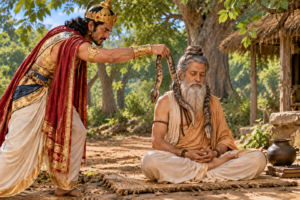
Why did I do that? I don’t know. I can’t fathom the reasons for my despicable behaviour even now. I have come to accept that this was how I would lose my mortal body. The sage was the epitome of peace and calm. He continued his meditation, unmindful of his surroundings. But someone else’s rage was bigger than mine.
“How dare you!” A voice from behind sliced through the fog of thirst, hunger, and fatigue. Startled by the sight before me, I stared in horror at what I’d done, then turned to the source of the angry voice and found a young, handsome hermit, his eyes radiating unforgiving ire.
I stood rooted as he came forward, grabbed the arrow from my hand, and removed the dead snake from around the meditating sage’s neck.
“How dare you?” He repeated, his voice choking with uncontrollable anger. “You have insulted the revered Sage Shamika. I am his son, Shringi, and I curse that you will die by a snakebite, by the King of Snakes, Takshaka, himself in seven days.”
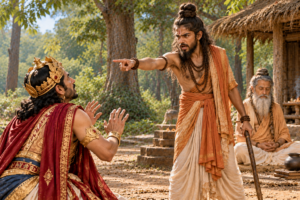
That’s it. In an instant, my death sentence had been pronounced.
My basic survival needs felt like nothing relative to the curse of death. (It is strange how relative everything is for humans). I was overcome with shame and embarrassment for my behaviour. I fell at Shringi’s feet and begged for forgiveness. All this commotion awoke Sage Shamika.
He heard our story, the angry version from his son, and the regrettable one from me. I surrendered at his feet. He looked at his angry son and said, “Oh! My dear Shringi, what have I taught you about controlling your senses and feelings? You still have a lot to learn.”
He then turned to me, lifted me from the ground, and said, “I am sorry for this, my dear King. But I can do nothing to reverse the curse. I’ve heard Kali has a way of multiplying all negativity, and that’s likely an explanation for your out-of-character behaviour and that of my son. Go, do what you need to do in this life before Lord Yama comes for you at the end of seven days.”
Parikshit and Takshaka
That was a week ago. Tomorrow is my last day on earth. My son, Janamejaya, whom I had crowned king of Hastinapur, was doing everything he could to keep me safe from snakes. But I knew my time had come.
Luckily for me, the last week had been nothing short of blissful. Sage Shukadeva, the revered son of the even more highly respected Sage Vyasa, had helped me realise peace through the eye-opening magical tales of Lord Vishnu. He narrated the Srimad Bhagavatam every day, and only a small portion remained for tomorrow before the Lord of Death held me in his irrevocable, deathly grip.
I went back into the little tent my son had built for me to live the last week in peace. I slept soundly that night.
The next day it dawned bright and clear. I found my son, Janamejaya, sitting at my feet, tears streaming down his face. I got up, lifted him up, and hugged him to my heart’s content.
He was devastated and yet hoped that, by some miracle, I would be saved. How could any snake bite me in this impenetrable tent he had built for me? Guards took turns to ensure no stranger was ever let in. Even the banks of the river I sat on every evening had a strong defence wall that kept me safe, or so my dear son believed. But I knew better. Death can come through storms. Manmade defenses are nothing to it.
So, we sat together for a while, me giving me as much sage advice as possible. I told him that everything in this world is illusory, including the lives we lead. The only permanence that is worth following is doing your karma to the best of your ability and leaving everything to Him. But I realised teachers can teach. But it is only learnt when the student is ready. Didn’t I do this learning only in the last seven days of my life?
When Janamejaya was somewhat consoled, we went out to get ready for the final day of Bhagavata Saptaham. My heart raced with joyous anticipation to listen to His glorious tales. I saw my son carrying a basket of fruit.
“This is your lunch, dear father. I made sure I picked the juiciest fruit for you since you have stopped eating anything else.”
“Aah! Thank you, my son. I will take it from you when I’m hungry.”
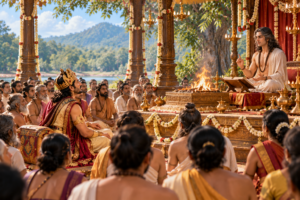
Sage Shukadeva and his disciples were ready for us in front of the Yagna firepit. They chanted mantras sonorously, and the sound rang through the neighbourhood, spreading joy, peace, and hope to all the listeners. My son and I sat down in our seats, looking at the huge crowd that had come to participate in the sacred storytelling ritual. I closed my eyes and gave in to the beautiful sounds of the mantras.
When the yagna ended, the sage began the last section of the Bhagavata Purana. He narrated Krishna’s passing on, a story so powerful that not a single eye was dry. By the end of the session, I was spent and yet totally blissful. My eyes had dried up completely, as if the tears in this lifetime had been used up.
I felt it in my heart. It was time. I was merely curious how my end would come. Suddenly, I felt the pangs of hunger. I hadn’t eaten anything at all that day, so rapt was my attention to Krishna’s stories.
“Janamejaya,” I called. He was talking to someone. He rushed to my side.
“Can I have a fruit you brought for me?”
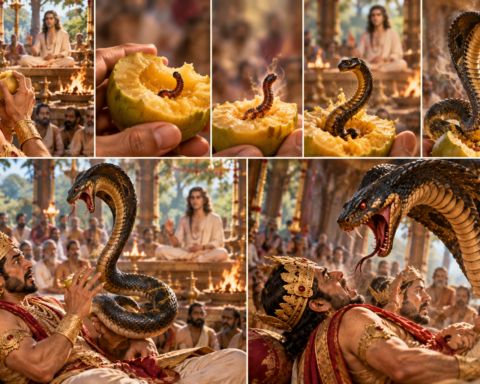
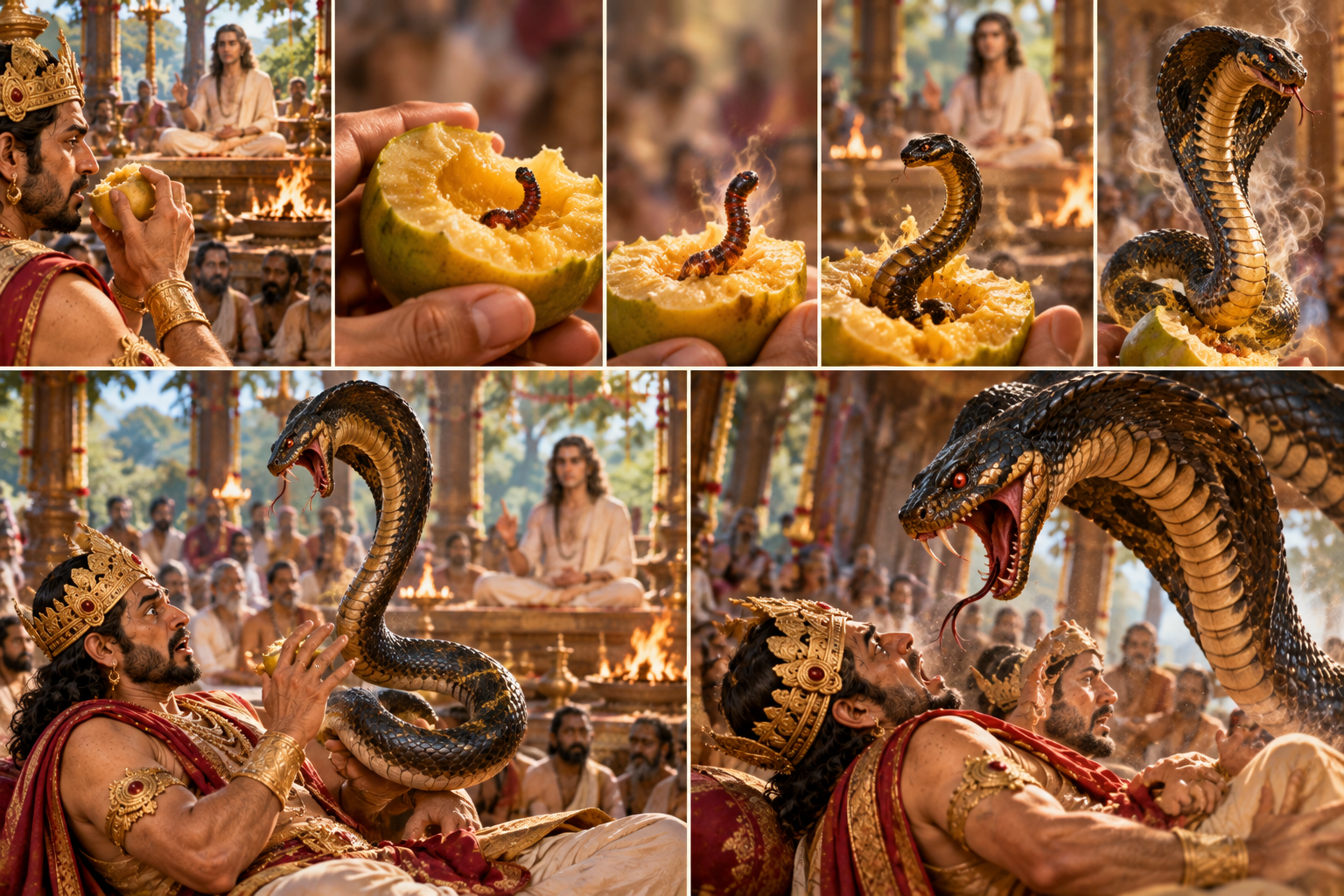
Smiling, he reached into the basket, took out one of the ripest, juiciest fruits, and handed it to me. I bit into its flesh, letting the succulence soothe my parched throat, and savoured the fruit’s sweetness. I opened my eyes to a collective gasp from the crowd.
Takshaka, the King of Snakes, in all his venomous glory, stood before me. His eyes seemed to smile at me, even as his tail released itself from the fruit I held in my hand. I realised how easy it was for death to find its way. He just needed a small place in a little fruit to fit himself in the form of a tiny worm, to rise up and strike when it was time.
I dropped the fruit and bowed low as Takshaka bit me. I felt his venom pass through my body before it hit my heart, and my soul was released from my body. I died exactly as Shringi said, bit by a snake. I am grateful the King of Snakes himself came to do the honour!
Author’s Note:
Pictures created using ChatGPT. This post is a part of Blogchatter Half Marathon 2.0.