

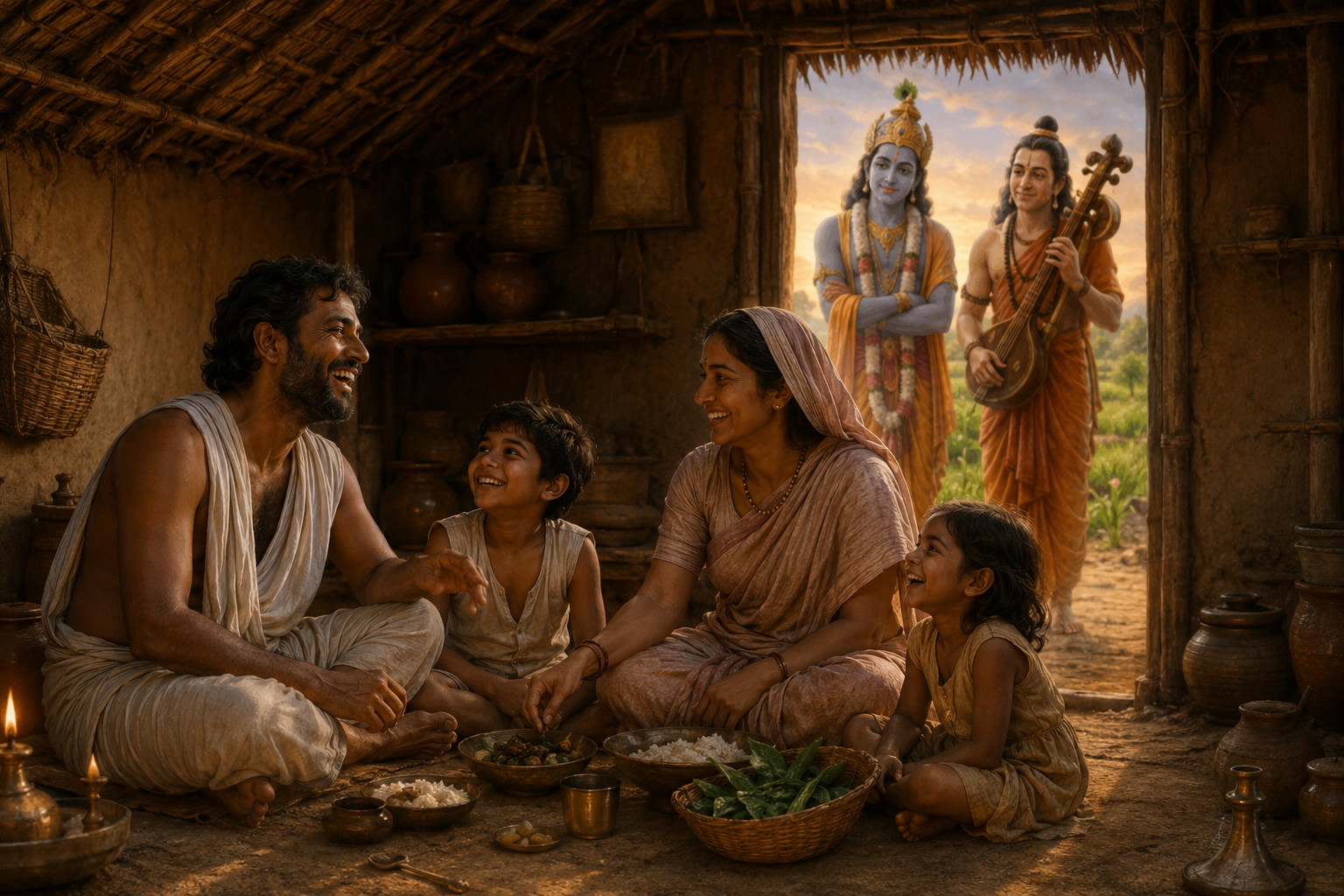
“What?” Narada’s shrill voice registered shock and disappointment. “I’m not your favourite devotee?”
Vishnu smiled, his eyes glinting mischievously. Here comes a tantrum!
Narada is Angry
“You are definitely one of my favourites, my dear Narada. But there are others who are as good and some even better than you, especially in the human world.”
“But I chant your name day in and out, in every breath I take. How can someone be a bigger devotee than I?” Narada trilled angrily.

But suddenly he remembered an earlier episode involving Tumburu and himself about who sang the best. That lesson in humility was still fresh. So, he decided to take a step back.
Controlling his emotions, he asked, “Lord, tell me who your favourite devotee is? I want to be like him.”
Vishnu hid his smile at Narada’s efforts at humility and replied. “Well, there are many men and women who are great devotees. But let me take you to Satyaki, a simple, poor farmer living in a little village along the Ganga.”
A farmer? That too, not a rich one? How can he be better than me?
Narada kept his thoughts to himself. Nodding to his lord, he said, “Can we go right now?”
“Yes, it’s the perfect time. Satyaki would be waking up right this minute to begin his day.”
The Struggle of Work Life Balance
The two of them disapparated and appeared, although invisible to others, in Satyaki’s home, a small but neat and clean hut where he, his wife, Madhavi, and their two children were asleep.
Satyaki awoke just as they reached his home. He got up, sat on his mattress, closed his eyes for a couple of minutes and chanted, “Hare Rama Hare Rama, Rama Rama Hare Hare. Hare Krishna Hare Krishna Krishna Krishna Hare Hare.”
By this time, Madhavi also got up. She chanted her own mantra, and the two of them went to the banks of the Ganga for their morning bath and ablutions.
Satyaki went to the men’s section while Madhavi walked towards a more secluded women’s section. Other men from the village were already there, all busy bathing and washing their clothes. They greeted each other and went on with their work, enjoying the gently flowing river, which shimmered like diamonds against the soft light of the rising sun.
One of the men asked Satyaki, “According to the roster, it’s your turn to plough Arjun’s fields, right?”
“Yes, I remember it. I will be there in his fields in the evening.” Satyaki nodded.
A small boy of about 10 years looked up from his cleaning chores and said, “My family is eternally grateful for all the help you are giving us. Since the day my brother, Arjun, got injured, each of you has been taking turns helping us with farm work. My brother told me to thank you all and to tell you that he should be fully recovered in a week’s time.”
Satyaki went to the child, hugged him and said, “What is the use of a community if we can’t help each other in times of need? Tell Arjun not to hasten the recovery process. Let him be fully healed before he returns to farmwork.”
The others in the group nodded in agreement, and there were murmurs of acceptance all around.
Satyaki finished his bath and took the path to his home. Madhavi had also finished her work and joined her husband to return home. At home, Madhavi hung up the washed clothes to dry and went to the kitchen to begin preparing the day’s meals.
Satyaki went to wake up his children and get them ready for school. They went to the local school where they learnt basic reading and writing. After two hours of schooling, both of them would sometimes join their father in the fields, and sometimes stay at home, playing with other children of the neighbourhood.
After a quick breakfast, Satyaki went to the farm.
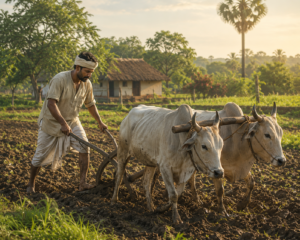
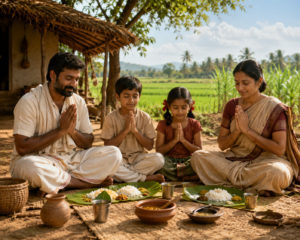
Narada and Vishnu followed Satyaki to the fields, where he worked in the scorching heat until noon, when Madhavi brought him lunch. The two children were with her. The four of them sat under the shade of a large banyan tree to eat their simple meal. Before starting, the four of them recited the Hare Rama Shloka thrice in chorus.
Lunchtime lasted nearly an hour. They ate slowly, sharing stories of how their mornings went. The young children discussed everything that had happened at school, including how Arjun’s sons, their best friends, were happier than before, now that their father’s recovery was progressing quickly and well.
After lunch, the children went back home with the empty dishes. Madhavi and Satyaki continued working on the fields. They stopped an hour before their usual time, walked across to Arjuna’s fields, and did some weed-pulling there, ensuring water was flowing through the irrigation pipes without blockages.
They also ploughed an empty part of the field, getting it ready to sow some vegetable seeds tomorrow. Arjun was there too, helping them with whatever his limited mobility allowed him.
Just before sunset, the couple stopped working and made their way home, where the children had done the prep work for dinner. Soon, they sat down to eat after washing at their well. Before dinner, another three rounds of Hare Rama mantra chanting.
Dinner was a quieter affair than lunch, with fewer conversations and discussions. A sense of peace and calm prevailed in the house, as if their bodies were telling them it was time to turn in after a hard day’s work.
Just before lying down to sleep, Satyaki planned the next day’s activities, then chanted the Hare Rama mantra one more time and fell asleep, after making sure Madhavi and the children were asleep too.
Narada is Baffled by Satyaki’s Simplicity
Vishnu and Narada returned to Vaikuntha. Narada was baffled. “Satyaki chanted your name four times in the entire day. The rest of the time he was so busy with other things that he didn’t even think about you, my dear Lord.”
“What other things, Narada?”
“Laughing and playing with his family, his work at the farm, helping other people in his community, eating, sleeping, and everything else but chanting your name. And look at me. All I do is chant your name and sing your praises, Narayana. And yet, you think people like Satyaki are your biggest devotees? That’s unfair, right?”
Vishnu’s smile reached his ears. This is exactly what he expected to hear.
“Can you refocus on the list of things Satyaki was busy with the entire day, one by one this time, and in order of the time spent?”
“Ok, here goes. The most time he spent was working on his fields. Almost eight hours of the day,” replied Narada.
“Indeed. And why does he need to work?”
“Well, it’s his job to provide for his family.”
“Correct, and according to you, is he doing that well?”
“Aah, I can’t fault him with that now, can I? He works really hard. And he loves his family. They are his first priority. In fact, at lunch time, his younger child wanted more food. And he gave a portion of his already small meal, and that too happily, as if seeing his children’s stomachs filled satiated his own hunger.”
“Absolutely! So, he does a great job of providing for his family through his work just as Madhavi works hard in the house while also sharing her husband’s farm work.”
Narada nodded vigorously. He continued, “Next, he spent quality time with his family before lunch and a long time in the evening before and after dinner.”
“And what did you notice during those times?”
“That the entire place rang with joyous laughter. The regaling of old and new stories, finding happiness in little things of life, remembering his and Madhavi’s dead parents and talking about how much they loved their family. He helped his children with schoolwork while Madhavi finished cleaning and cooking. He even helped Madhavi clean up after their dinner.”
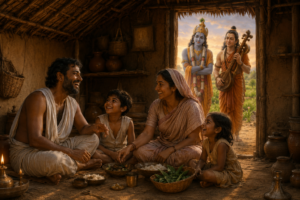
“What does that tell you, Narada?”
“That he is a great father and a wonderful husband.”
“Correct. What else did he spend time on?”
“Helping a member of his community, Arjun, who was temporarily disabled.”
“What does that tell you about him?”
“That he cares for his community too, and is always ready to give a helping hand. In fact, the community followed a roster for such matters, taking turns to help people in need. Like an insurance policy. You give when others need, and you are likely to get when you need.”
“I can’t fault your observation skills, my dear Narada. And yet you don’t understand why I think Satyaki is one of my favourite devotees.”
“Of course I cannot understand. He hardly chants your name! He is so busy with other stuff.”
“But he is busy with his duties and responsibilities. That comes first for him. Yes, even above chanting my name. Because he is a householder and takes the duties of a grahastha very seriously, working very hard to maintain work life balance. You’ll perhaps never understand how hard he tries to balance work (to provide for the physical needs of his family) and living a good, happy life (to provide for the emotional and spiritual needs of his family). He is a master balancer.”
Narada stayed quiet, imbibing the lessons Satyaki’s life was teaching him. He stared unseeing into the horizon even as Vishnu continued, “By the way, you witnessed a relatively ordinary day in his life. Quite often, he has to deal with other issues, illnesses, the grief of death, the pain of material and emotional losses, old age that brings lesser energy while not always reducing his responsibilities to provide for people dependent on him.”
“And those are just his regular problems, perhaps, a wee bit under his control. Sometimes, he has to deal with issues that are unequivocally beyond his control, like droughts, natural disasters, cruel rulers, mad rulers, wars, and so much more. Regardless of all that, Satyaki and people like him never lose an opportunity to offer prayers to me for strength, courage, and, most importantly, gratitude. He never forgets me, and he strives to balance between working and living, even when he seems lost in the chaos of human life. And that’s what I find most appealing about people like Satyaki. He is, unconditionally, my most favourite kind of devotee.”
Narada’s eyes glistened with tears as he listened to the struggles of human beings. “Forgive me, my lord. Each time I allow my ego to cross a boundary, you and your devotees pull me back from total self-annihilation. Thank you for this wonderful life lesson.”
Vishnu laughed merrily and said, “Come, let us go and check out one more person like Satyaki, struggling to maintain sanity in a chaotic world but never forgetting to be grateful.”
Author’s Note:
There are many stories in our folklore involving Narada and lessons in humility. This story is one such. I have taken the creative liberty to tweak it a bit to fit the problem of work-life balance that human beings have been trying to keep since time immemorial. I have replaced the desk to farm.
This blog post is part of ‘Blogaberry Dazzle’ hosted by Cindy D’Silva and Noor Anand Chawla
in collaboration with Tanvi Agarwal.
This post is a part of ‘Beyond the Desk Blog Hop’ hosted by Manali Desai and Sukaina Majeed under Every Conversation Matters blog hop series
Images created using ChatGPT





I could never imagine finding a lesson in work-life balance from our folklore. I thought this was a modern day issue. But hats off to your creativity and knowledge that showed us a picture of the ordinary life beyond the desk.
What a lovely way to say nice things about my creativity. Thank you, Pinki. But I believe the stories in our puranas and itihaasas are so rich and varied, they cover almost every aspect of human life, it’s past, present and future.
It’s interesting you took the desk to the farm. The story is great. Fulfilling our duties and striving for a healthy work-life balance is the highest form of devotion. I love that.
Thank you so much for your lovely comment. That’s exactly what I wanted to say.
It’s a wonderful perspective on how balancing duty, family, and community is a true spiritual practice in itself!
Ma’am, your stories are so mesmerizing, truly filled with knowledge nuggets. I would suggest you come up with a collection of these and publish them. Thanks for this one ❤️
Thank you for the encouragement, Nilshree. Some day, the book idea will materialize.
So well written! Finding the right balance isn’t always easy, but even mythological/folklore stories can end up encouraging us to be more intentional about it.
What an amazing storyteller you are. Such an important lesson from a mythological piece, so relevant still today.
Another brilliant story from your pen! How well you have brought the idea of work-life balance through a mythological background! I agree with Nilshree! You must bring a book out on your wonderful stories!
Wonderful post. To think that a mythological story can be woven so well to fit a modern theme of work-life balance. Kudos to your imagination and your creative pen, or should I say keyboard:)
Your story is so heart warming and beautiful. Taking care of work and family in equal measure is so aptly shown here. Love your story.
Thank you, Malvika. Yes, dealing with daily struggles while keeping your faith intact is,I believe, the best form of devotion.
The art of work-life balance through Indian myth is an excellent thought. Narada is a symbol of gratitude, and his story with Satyaki is just amazing to read.
Thank you!
quite a refreshing take on work-life balance from the folklores of Hinduism
Kudos, you have decoded the folklore clearly and simply. God loves those who abide by life dutifully and the rest is balanced with their behaviour and attitude. What a beautiful way to express work-life balance.
Awesome tale of Narada eating humble pie again, Ratna. When I see Gen Z, I try to talk to them about work-life balance, but no one understands. My daughter is a total workaholic and has ruined her health. When my kids were babies, I would not be able to go to the Gurudwara. My dad used to tell me that looking after and nurturing your family is the best way to be religious. I find it so reassuring that your story points to the same.
I am always left amazed wheneever I read something from mythology that still aligns with today’s time. Well written
Using Narada’s ego and Vishnu’s gentle lesson to unpack work-life balance is genius, and moving the setting from desk to farm makes it land even better. The idea that doing your duties well, providing for your family, and helping your community are themselves the highest forms of devotion really stayed with me.
I remember a very similar story where Vishnu asks Narada to carry a pot of water on his head and once he is done, vishnu asks him how many times Narada chanted his name. It was zero because Narada was focused on ensuring no drop of water falls. So same lesson about being able to remember god at all times. I really like these stories.
Never thought we would find a work-life balance lesson from a Vishnu and Narada story. I believe that God resides with us whether we call out his name the entire day or not. Karma too is a kind of puja, right?
I absolutely love your way of telling the stories. This was one I haven’t heard
Another interesting story from your bag, Ratna. Thanks for sharing. A valuable life lesson learnt.
Another interesting story from your bag, Ratna. Thanks for sharing. A valuable life lesson learned.
Read this again for #BlogaberryDazzle and am fascinated all over again, especially at how you managed to connect mythology to a modern concept like work-life balance. Cheers!
Thank you, Manali
Reframing devotion around Satyaki’s ordinary day, farming, family, community, rather than constant chanting, is such a refreshing lens. It reminded me that showing up fully for the people around you can be its own kind of prayer. Narada’s ego getting gently humbled again never gets old, and Vishnu’s patience with him is honestly the best part. Beautifully told, this one is staying with me.
Thank you, Arsh!
This captures the daily struggle of balancing responsibilities beautifully. The honest reflections feel practical and relatable. Sometimes, setting boundaries is the real key. A thoughtful reminder to make space for ourselves too.
That’s such an important lesson to take away: one needn’t perform difficult rituals or observe elaborate fasts to be in God’s good books. Sometimes, all it takes is a heartfelt inner call, a sincere prayer, or simply chanting His name with love and faith. I truly loved your story.
What I loved about this story is how it takes a very modern struggle—work-life balance—and finds its roots in our mythology. Satyaki’s life beautifully shows that fulfilling your responsibilities, caring for your family, helping your community and still making space for gratitude can itself be a form of devotion. For me, the biggest takeaway was that spirituality isn’t always about how much we pray, but about how sincerely we live the life and responsibilities we’ve been given.