

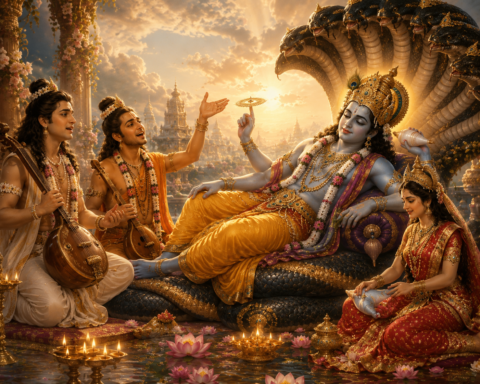
“Krishna is dead!” “Krishna is no more!” “The Yadava Clan is wiped out.” Arjuna cried. He had just returned from Dwarka, where he had seen the devastation wreaked on themselves by the Yadavas. “Dwarka itself is submerged under the ocean,” the third Pandava brother whispered, the horror of witnessing the horrendous sight reflected in his eyes.
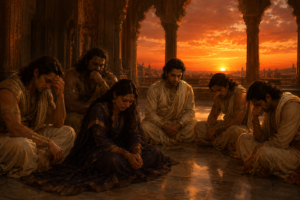
Like sharp, deadly arrows, these words pierced the hearts of the Pandavas and Draupadi. They sat in the grand court of Hastinapur; each lost in deep grief, lost to the world, lost in their thoughts of the King of Dwarka.
Krishna was not just their friend or brother. He was their mentor, their unnamed commander, their refuge, their everything. The six of them couldn’t imagine a world without Krishna. The crimson-orange rays of the setting sun were symbolic, as if telling the six of them to prepare themselves for their own exit from this world.
The Decision to Journey to Swargarohini
Yudhishthira broke the deafening silence of grief. “I think it’s time for us too.”
The others looked at him, their eyes sparkling with tears reflecting the setting sun. “Yes, there is nothing left for us here. We have done everything,” echoed Bhima, as he stared at the mirror, unwittingly admiring his sinewy muscles rippling with strength and power, even in this moment of grieving for their mentor.
“I wish he had told us about Mother Gandhari’s curse. I would have been there for him and the Yadavas, using my physical strength to prevent their destruction.” He said.
Arjuna nodded in silence, the most heartbroken of the lot. Krishna was special to all of them, but extra special to him. Without him, he would have been a lost puppy, meandering through life without a purpose, running away from his duty. Krishna gave him the gift of the Gita, a lesson for humanity, not just for him, but one that would outlast life itself and move on to the next Kalpa.
He replied to Bhima, “Yes, he should have told us about it. I would have helped him deal with it with the power of the bow and arrow.”
Nakula, the younger of Madri’s twins, added, even as he stared at the mirror, his handsome face filled with sadness, “We could have done something to prevent the catastrophe at Prabhasa.”
Sahadeva, the younger twin, replied, “I could have used my knowledge and wisdom to find a solution for Krishna. Why didn’t he let us know?”
Draupadi sobbed her heart out, looking at Arjuna for solace. He didn’t even look at her, so absorbed was he in his own grief. Bhima caught her needy eyes, nodded his understanding of her pain, and said, “Don’t be sad, Draupadi. He didn’t want our help for whatever reason, and no one knows what has to happen more than him. As Yudhisthira says, I think it is time for us to leave, too.”
The eldest Pandava looked at each of his brothers and their wife, Draupadi, with a strange kind of light in his eyes.
Finally, he said, “Yes, let us prepare for our final journey. We’ll hand over the kingdom to Parikshit, give away all our belongings, and leave immediately. Arjuna, let your grandson know of his responsibilities as the next ruler of Hastinapur. He is ready, of course. The wisdom of his father, Abhimanyu, is already embedded in his genetic memory. Still, give him your last words of advice, and let us begin the preparation of our journey.”
In a couple of days, they had no material possessions except the garments covering their body and their minds and souls. The last 36 years had been difficult, very difficult. Even now, the hearts of the five brothers and Draupadi were heavy, heavy with the unnamed curse of carrying their bloody burden of killing thousands of people, sparing no one, including their elders, teachers, cousins, brothers, and more.
The family had won the Kurukshetra war, only in name. The throne was theirs at the end of the bloody 18-day war. But they were left alone. No other family but themselves. Even their beloved sons were gone. The elders who remained alive at the end of the war went to the forest to spend their last few years in sanyasashrama, the final leg of their lives devoted to spiritual contemplation.
The duty to rebuild Hastinapur to revert it to its glory before the gory war and make it safe and prosperous for their subjects was the only reason Yudhishthira sat on the throne. Slowly but surely, the Kuru empire regained its power and strength. The Kuru family grew as grandchildren married and had children of their own. Parikshit was ready to take on the mantle, and the six of them were more than ready to begin their journey of passing on. They had had enough of this birth.
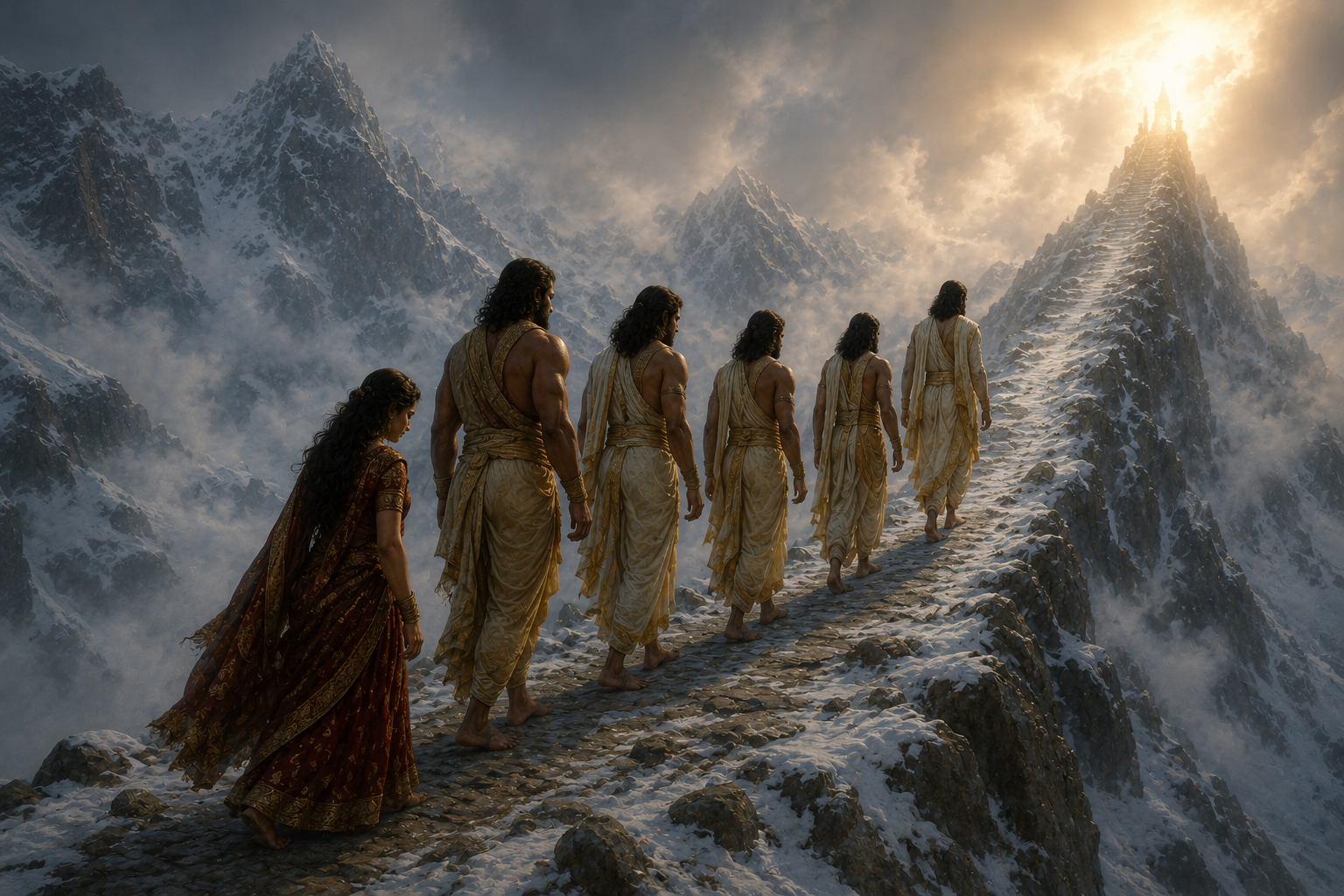
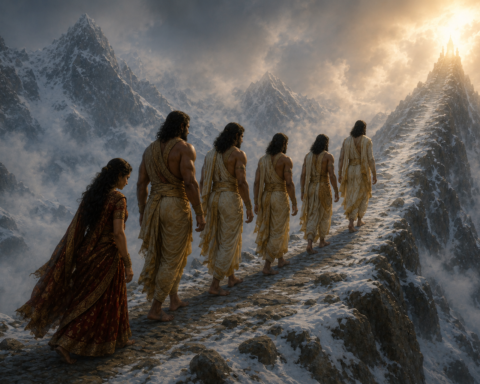
With relief, the five brothers and Draupadi began the long, arduous journey to Swargarohini, the stairway to heaven. They wanted to enter heaven in their human form. Only the most virtuous could do it. Any lesser person would fall dead before reaching Swargarohini.
So they tried to test their moral degree, although nearly all of them lived in the illusion that their goodness was irrefutable. After all, didn’t they take suffering and pain with regal stoicism? Didn’t they do everything according to the laws of Dharma? Isn’t that the reason why Krishna was on their side? Didn’t they forgive their cousins for their treachery, even if they had no choice but to kill them in the war? They were above the common moral ground!
Swargarohini Beckons – They Start Falling Dead
Yudhishthira led the way, followed by Bheema, Arjuna, Nakula, Sahadeva, and finally, Draupadi. In a single file, they walked the mountainous path toward their destination. An unknown dog joined them on this journey, keeping pace with the Yudhishthira.
They crossed Mana village and had travelled just a few yojanas when Draupadi fell dead. Bhima, Arjuna, Nakula, and Sahadeva were shocked.
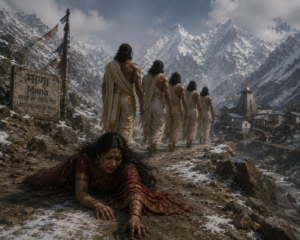
“But why? She suffered so much, even losing her children in the battle of Dharma. She was a virtuous wife, sharing her love equally with us,” Bhima, the one who loved her the most, cried piteously. “She definitely deserved to reach heaven in her human form.”
Yudhishthira’s eyes filled with tears, too, and yet he knew his beloved wife fell short of perfect virtue. “She did not love us equally, Bhima. She always favoured Arjuna more. This partiality towards Arjuna is her undoing. Her time is done. Let us do her final rites and move on.”
They did as their eldest brother commanded, their illusion of moral righteousness beginning to fade. They were all heartbroken with the passing of their beloved wife.
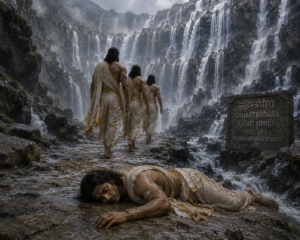
Next to fall dead was Sahadeva, near Sahastradhara, the place of a thousand waterfalls. “He was very proud of his knowledge. He forgot he was only a cog in the cosmic machinery,” Yudhishthira consoled his remaining four siblings. They moved on after the final rites of their youngest brother.
Their hearts heavy with sadness and renewed self-doubt, the four of them walked towards Lakshmi Van, the region of Bhoj Patra or birch trees, where Nakula died. “His vanity about his good looks came in the way of leading a wholly virtuous life,” the eldest Pandava said, his eyes misty at the sight of another dead brother.
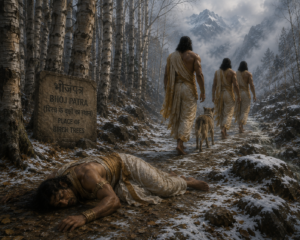
No attachment! No attachment! Their work is done. Their bodies are gone. Their souls are eternal.
Yudhisthira focused on the mantra of surrender and detachment as they performed Nakula’s last rites and walked on.
At Chakratirtha, Arjuna fell dead. Bhima was inconsolable. Yudhishthira held his only surviving brother in a warm hug. “His ego, overconfidence, and vanity did this. He was so overconfident that he made a promise he couldn’t keep. Remember how, in a fit of anger, he said he would destroy all his enemies in one day, which, of course, he couldn’t keep.”
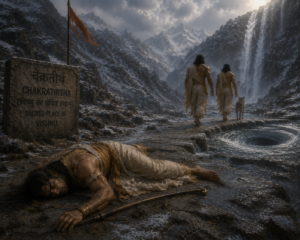
“No human is perfect, and by extrapolation, no family is perfect. Yet, the familial bond that connects us drives us to fight for our family. As humans, the family is the smallest unit of a community. Happy, hardworking, morally upright families make a powerful village. Many such villages make a great empire,” the former king of Hastinapur concluded.
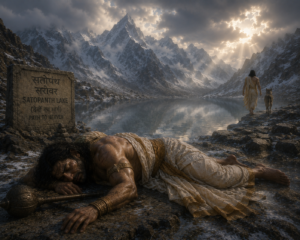
Completing Arjuna’s death rites, the remaining two brothers continued their final journey. Bhima was both sad and angry. All their hard work and dedication were to no avail. None of them was worthy of reaching heaven in their human form. He then looked at Yudhishthira, walking ahead of him, the pain of supporting his family sagging his shoulders. They had reached Satopanth Lake.
He walked up to his brother and said, “You knew, right? You knew none of us was ready for heaven. When we were discussing our journey and the death of Krishna, there was an inexplicable light in your eyes.”
Dharmaraja smiled, “Yes, my dear Bhima. We are humans, and frailty, vulnerability, and desires are part and parcel of our lives, regardless of our position in society. In death, we are all equal. Our bodies are shed, and our souls take up the karma picked up in this birth to be added to our bottomless sack of sanchita karma.”
He looked at Bhima with tears in his eyes, “You too, Bhima. Your vanity regarding your physical strength will be your undoing in this birth.” Even as he said these words, Bhima fell dead at the banks of the Satopanth Lake.
Yudhishthira Left Alone
Yudhishthira sobbed uncontrollably at the sight of his last brother’s corpse. It was over; his family, as he knew it, was done. His beloved brothers and Draupadi gone, he thought he should also give his body up. Suddenly, he realised his folly. He recalled the words he just spoke to Bhima and realised, “This body is nothing but garments covering the undying soul. Why should I weep so much when I know death is nothing more than just a blip in the eternal cycle of life until the soul is ready to merge with the One?”
He completed the final rites for Bhima and continued on his way. He looked at the dog, which had been walking with them right from Hastinapur. He turned to it and said, “You should go back, my dear friend. My time will come, too. Go back to your family and be happy.”
But the dog refused to leave Yudhisthira’s side. Sighing, he walked on, and the dog followed. He reached the stairs to heaven at Swargarohini and climbed up. Soon, the gates of heaven opened so he could enter. Just as he was going to cross the threshold, a voice said, “Stop, you can enter only if you leave the dog behind. That animal cannot walk into heaven.”
Dharmaraja replied. “No, that is not going to happen. For some reason, this loyal dog has accompanied my family. We have formed a bond with it. If the dog doesn’t get in, I will stay here with it. I cannot abandon someone who has put his faith in me.”
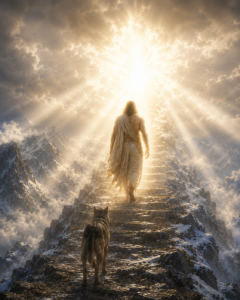
He pulled back his foot and sat down at the entrance to heaven, the dog curling up beside him. Suddenly, there was a burst of light, and the dog disappeared, and in its place stood Yama, the Lord of Death and Righteousness, Yudhisthira’s father. He smiled at his son and said, “You had already the test of dharma when you answered my questions when I came as a Yaksha to you. This was the final test, and you have passed admirably. You deserve to enter heaven in your human form.”
The doors of heaven opened, and Yudhishthira walked in, to be swallowed into heavenly light.
Author’s Note:
The final journey of the Pandavas toward heaven is told in the Mahaprasthanika Parva of the Mahabharata.
This post is a part of ‘Fam Jam Blog Hop’ hosted by Manali Desai and Sukaina Majeed under #EveryConversationMatters blog hop series

You’ve narrated this so well. Even though the story is familiar I enjoyed reading it yet again.
Ratna, I enjoyed this narrative as much as I enjoyed your Blogchatter posts. How strange that after living full lives, the final step to heaven is the most difficult step of all. It goes to prove that all humans have frailties.
Human frailties, indeed. Thank you for your thoughtful comment
I have heard it but got a chance to read the last journey of the Pandavas first time in detail. Thank you!
You have narrated the final journey of Pandavas and Draupadi beautifully.
Thank you, Malvika
What an enriching tale of the last days of Pandavas. And the story of Dharmaraj dusguised as dog.
Thank you, Reubenna
This was new to me. Thank you for describing it in such a detailed way and the images go with the words so aptly. Wonderful job.
Thank you, Nilshree,for your lovely words of praise
Your writing is evocative and immersive! Though the story is known, yet, the play of words, the emotional tension made it impactful! The Pandava family has been so well portrayed in this story.
Thank you so much, Anamika. So happy the ‘family’ bit came through.
You know, I could never understand why Yudhishthir could be so callous to his brothers and wife, and yet so loving to a stray dog. Your story has given me a lot to think about.
Thank you, Harshita.
I’m not very familiar with many of these stories, so I always appreciate how simply you tell them. This one felt less like a myth and more like a journey about choices, duty, and letting go. A thoughtful read.
Thank you, Sadique, for your kind words.
Thank you, Saadique.
I didnt know so many intricate details, though I knew that after Krishna’s passing away the Pandavas began their journey to heaven and all except Yudishtra could not reach heaven. Thanks for sharing this. Oh, I also didnt know that Yudishtra was Yama’s son.
Thank you, Janaki. Yes, many of our stories and episodes in the Puranas and itihaasas are given in amazing detail.
Read about it in detail for the first time. Thank you so much for the beautiful narration and depiction.
Your narration makes me feel as if I am at a discourse, listening to the story rather than reading it. Though a familiar tale but you keep adding the little something to make it interesting.
Thank you, Chandrika
Thank you for sharing this story, though they were walking toward heaven, they were still in their mortal bodies. One by one, due to their subtle worldly attachments and flaws, they began to collapse and failing so close to the goal.
Even Dharmaraja had to face the final illusion due to the half-lie he had told.
Reminded me to watch Dharmakshrtea series again! 😄
Yes, human flaws make us imperfect. And Dharmaraja was as imperfect as any of his brothers. Thank you for your lovely comment.
How beautifully you have paraphrased an entire chapter of the Mahabharata into a single post and even managed to convey the underlying message.
the narrative is so captivating. loved the expression in the narrative. kept me hooked. beautiful. 🙂
Thank you so much, Sukaina!