

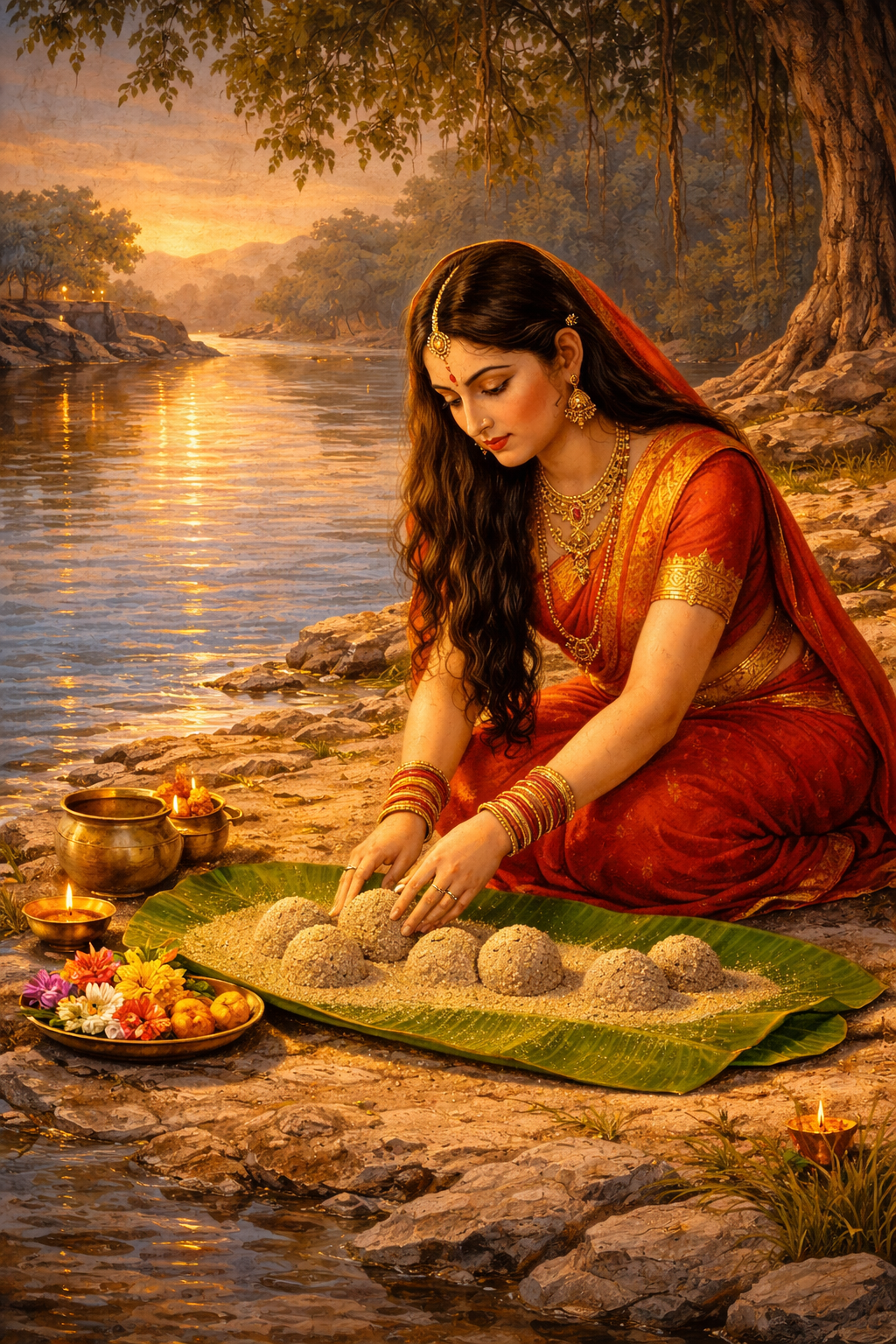
Sita and Dasaratha on the Banks of the Falgu River
Sita sat on the banks of the Falguni River, awaiting the return of her husband and brother-in-law, who had gone to procure the things needed for the pinda-dhan of her father-in-law, King Dasharatha of Ayodhya, who had recently passed away.
They heard the news of his passing while they were in exile. The three of them were shattered by it, but her husband, Prince Rama, was the worst hit. He cursed himself and his fate for being absent to do the necessary rituals for the peaceful passing of his father’s soul to the other world.
He cursed himself and his destiny for the suffering his exile brought to his father. He wished he could have done differently. But Sita knew that accepting the condition of exile imposed by Mother Kaikeyi was the only thing her husband would have done, no matter what. Following his parents’ command was his first duty as a son.
Today, after a couple of months of being in exile, when the news of King Dasaratha reached them, Rama and his brother Lakshmana decided to perform Pind-Dhan for their father.
Suddenly, she heard a voice, “My dear Sita.”

Startled, she turned and saw her father-in-law’s soul talking to her. She bowed low and paid her respects.
Dasharatha said, “I am hungry. Where are my sons? Why the delay in giving me Pind-Dhan?”
Sita replied, “They should be back soon, Father. Your sons have gone to procure the items for the Pind-Dhan ritual.”
“I cannot wait any longer. I am very, very hungry. You can offer it in their place, my dear daughter.”
“But shouldn’t only the son offer Pind-Dhan for the father? Am I allowed to do it?” Sita asked, uncertainty writ large on her face.
“It’s been a long time since my soul left my body. I’m yet to receive food from any of my sons. You are my daughter, and hold as much right as my son to do the ritual. Summon your courage, and do the Pind-Dhan ritual as quickly as you can, my dear girl.”
Sita wondered what she could do. She didn’t want her father-in-law to suffer from hunger pangs. She could see him writing in agony, just as she was told, souls would feel if Pind-Dhan was not offered regularly by their living children.
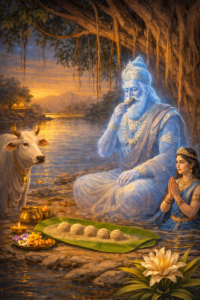
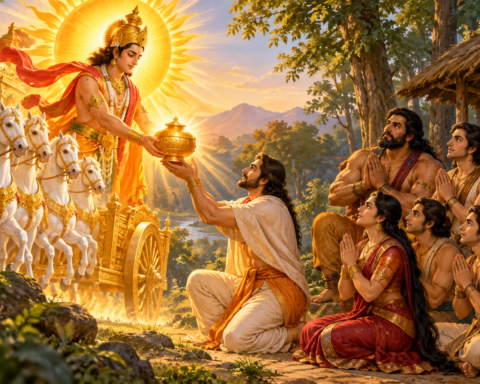
She decided she needed to do something. She quickly made Pindam from sand on the banks of the Falguni River and offered it to her father-in-law, who consumed it under a banyan tree. The ketaki flower from a nearby tree, the Goddess of the Falguni River, and a cow grazing nearby were all watching the entire episode along with the banyan tree.
His hunger satisfied, King Dasaratha’s soul resumed its journey to the other side, hoping the Pind-Dhan would happen regularly as stipulated in the Shastras, even as it gave thanks to Sita for her goodness.
The Falgu River, the Cow, the Ketaki Flower, and the Banyan Tree
Soon after, Rama and Lakshmana returned to hear Sita’s encounter with their father. Rama was happy for his wife, who had the good fortune to see her father-in-law, though he wept over his ill luck at missing the opportunity to say goodbye to his father a second time.
Sita consoled her husband, saying, “Don’t worry. He is happy with his destiny and has few regrets. He said all his regrets have drowned in the happiness of his four children, especially you, my dear husband. He told me to tell you that he is proud of your decision, and that you would one day be worshipped as the ideal man, the Purushottam.”
Rama hugged and thanked Sita for her kind words. He asked, “You’re sure he was happy with the Pind-Dhan you made? We could offer another one”
“Yes, my Lord, he ate it to his heart’s fill and left satisfied. He isn’t here to receive any more Pind-Dhan.”
“I see,” said Rama. “I wish you had some witnesses for the event so my heart could be at peace.”
“I did have witnesses, my Lord. The ketaki flower on this tree, the Goddess of the River Falguni, and the banyan tree under which your father sat and consumed the Pind-Dhan are my witnesses. Here, let me speak to them.” Saying this, Sita walked towards the ketaki flower and asked.
“Did you not see me offering Pind-Dhan to King Dasaratha?”
The ketaki flower was flummoxed, as this was the first time she had been called as a witness. Fear took over her senses, and, impulsively, the ketaki flower replied, “No, I did not see anything.” She turned away from Sita, refusing to hear any further.
Angry at the ketaki flower, Sita now called out to the cow with the same question. The cow, hearing the untruth from the ketaki flower, decided, for some inexplicable reason, to do the same thing and denied seeing anything.
Furious and sad, Sita now walked to the edge of the riverbank and called out to the Goddess of the Falguni River. “Dear Goddess, did you see me do the Pind-Dhan with sand from your banks for my father-in-law?”
The Goddess, unable to summon the courage to accept commitment for something as profound as a death ritual, replied, “No, my dear Sita. I did not see anything.”
Now, Sita’s anger knew no bounds. She still had one more thing left to try. She walked to the banyan tree and pleaded, “Dear banyan tree, did you see me offering the ritual for my father-in-law?”
The banyan tree was wise and truthful. Without a second thought, it replied, “Oh yes, I did see you offering the ritual with care and devotion. I also witnessed how happy King Dasaratha was with your loving devotion. I heard him say all the things you told your husband about his state of mind.”
Sita, Rama, and Lakshmana were very happy at these words. The brothers were glad their father’s soul was satiated. Ram thanked his wife profusely for doing his duty for him.
But Sita was still furious at the ketaki flower and the Goddess of the Falguni River. She cursed the ketaki flower, “You will never be used for the worship of Lord Shiva.” She then said to the cow, “You have spoken a lie, and therefore, only your rear end will be worshipped, not your mouth.” And she cursed the Falguni River, “You will remain invisible under the sand always, except for the monsoon season.”
Then, Sita blessed the banyan tree, “Since you had the courage to speak the truth, you will be immortal and sacred.”
Author’s Note:
This story appears in Odia Ramayana and in local Odia folklore. Even today, the effects of Sita’s curses can be seen. People bow to the cow’s hind quarters and not to its face. The ketaki flower is never used in the worship of Lord Shiva (although another story associated with the Pillar of Fire and Tiruvannamalai for the same exists).
Even today, throughout the year except during the monsoon, the waters of the River Falguni are under the sand. People performing death rituals in Gaya (according to the Gaya Mahatmya in the Vayu Purana) have to dig up sand to obtain water for the rituals. The sacredness of the banyan tree is indubitable
Since there is no F in the Indian script, I have taken the liberty of using the sound of PH for F. Falgu River is spelt as Phalgu River and is also known as Phalguni River.
This post is a part of BlogchatterA2Z Challenge 2026
Images created using ChatGPT

What an interesting anecdote, one that is not very well known! Indian literature is replete with such beautiful accounts. Thank you for sharing this one from Odia folklore.